Saturday, 5 May 2012

EXP2: Final Electroliquid Aggregation

I decided to do my final electroliquid aggregation in three ways. First I let fate decide, spreading the words around face-down into an order then turning them the right way up - this allowed me to let go of any assumptions or structure and maybe come across something entirely new or creative. However it just seems to make no sense.

Randomised electroliquid aggregation
I then got a friend to come along and rearrange the cards in any way he found interesting. I really liked what he came up with so I decided to base my own idea on that.

A friends advice

I decided to settle on a Haiku structure for two reasons. Firstly, it is in keeping with the Japanese theme, provides a poetic structure and appeals to my personal aesthetic interests. Secondly, the English Haiku is derived from the original Japanese via a sort of eletroliquid aggregation - when you consider that the original Haiku (or hokku) was developed in medieval Japan, and the modern Haiku was an adaptation by the imagists (Ezra Pound, Jack Kerouak) who lived in a post-modern/consumerist industrialised West, it is a blurring of the material (the natural focus of original hokku) and the immaterial (the imagist).

The structure of a Haiku is:

  • Use of three lines of up to 17 syllables;
  • Use of a season word (kigo);
  • Use of a cut or kire (sometimes indicated by a punctuation mark) to compare two images implicitly.


I obviously do not have a literal "season" word but as I'm in a post-modern mood, I guess you could take both the meaning of lightness and transience as kigo. Lightness as a representation of the day, and transience as a representation of the relationship between space/time and therefore the seasons. The colon : for the kire was an obvious choice. After playing around for a while I came up with a short statement. I love the rhythm, I love the blurring of meanings and I love the way that after reading it you feel your mind simultaneously empty and full (the very purpose of mu: the concept of nothingness).

My Haiku electroliquid aggregation

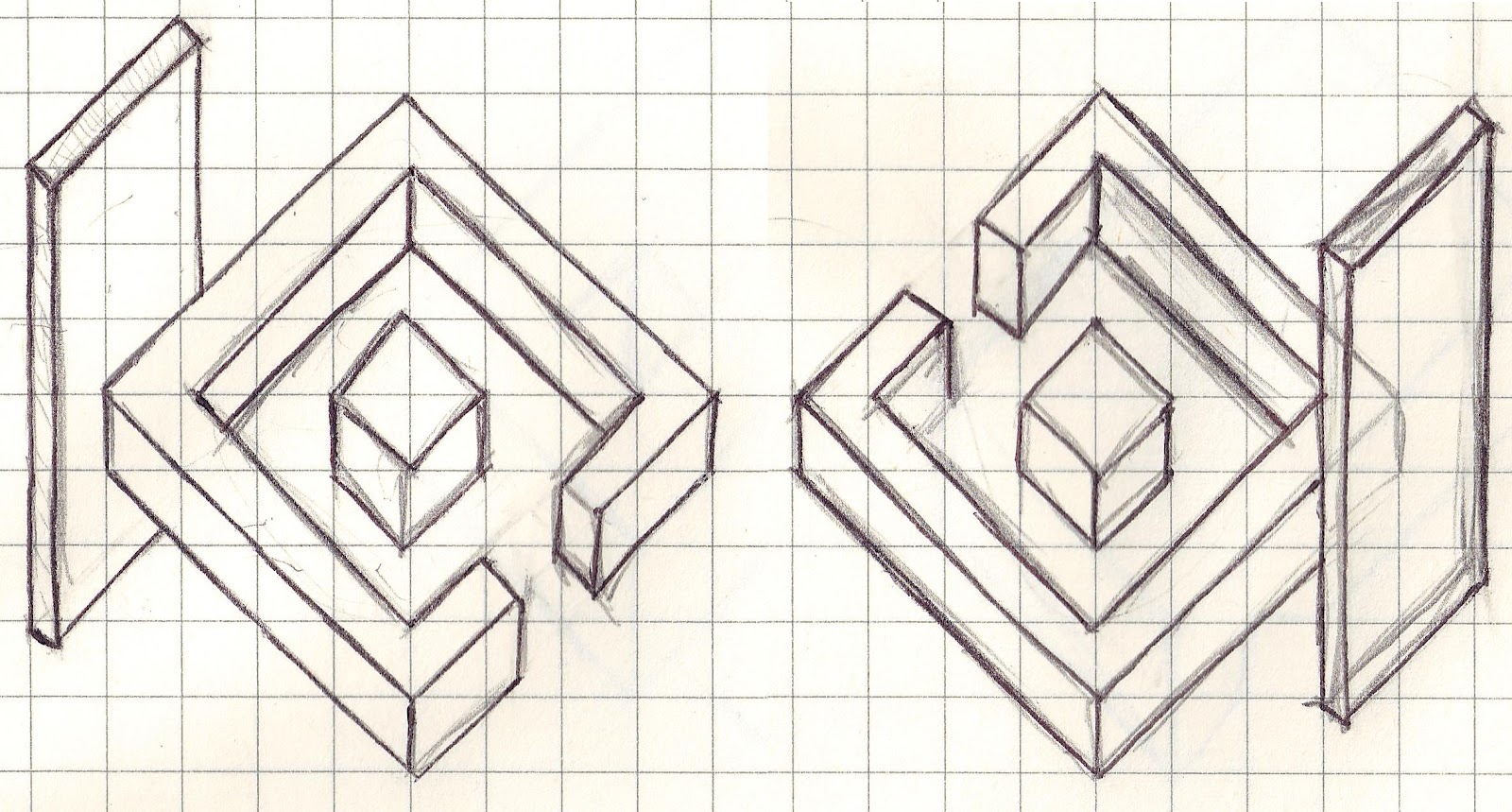
With this statement in mind I went back and pulled and played around with my ELA models. Oddly enough I settled on a design which was almost identical to the original "nothingness/lightness" ELA I came up with in class. Combining the two I ended up with a two part structure. One I call the sundial, while the other is the obelisk. They are joined by the void which cuts them into two.

Original Sketch

The Sundial
The Obelisk

EXP2: Electroliquid Aggregation Sketches

These are my axonometric sketches combining the two themes. I have decided to develop the Mu/Lightness combination because I think it is the most interesting and yielded the best result when combined.


EXP2: Axonometric Sketches

Mu: Concept of Nothingness (fragile transience)

Freedom of Discipline (freedom of spatial composition between floor and ceiling)

Repetition of form

Minimal/elegance/simplicity

Wall-less Separation (implied separation)

Lightness (of mass)

Wednesday, 18 April 2012

EXP2: First steps with CryEngine

I imported my Experiment 1 piece into CryEngine to test out the workflow and get a feel for the engine and image captures.


Wednesday, 11 April 2012

First Year Struggle Street

Here is some useful advice which will make life easier:

Accessing the R Drive
If you need to access the R: drive and can't get into the Red Centre you can do it from home. Click here for instructions from BECU.


Getting CryEngine working
First you have to download CryEngine but I'm sure you can figure that out. These steps will fix those annoying Cryinput.dll, login errors etc.

I did this on Bootcamp using Windows 7 but it should work for most computers.

  1. ‎Disable antivirus and firewall.
  2. Extract Cryengine to C:/x
  3. Install this - http://www.microsoft.com/download/en/details.aspx?id=8109 (old version of DirectX that is compatible with CryEngine... lame, but small)
  4. Install this - http://www.microsoft.com/download/en/details.aspx?id=5582 (all the important parts of Visual C++ without the junk)
  5. Go into CryEngine/Tools/ and double click CryDevLogin and wait for a minute. Then try the editor!

I plan to add to this as the year goes on and other big issues come up.

Sunday, 25 March 2012

EXP1: Final Post

I have named my structure the Blossom Gallery. This reflects its aesthetic structure, and also the concept of growth and evolution. As a bud flowers into a new aesthetic and functional being so will humans evolve organically and technologically. Furthermore the bud exposes its once protected interior to the danger of the outside world. Both these concepts are relevant in the artworks of Stelarc and Louise Bourgeois.


This is a view looking into the outdoor exhibition space which is composed of juxtaposing columns and concrete stages with natural undulating landforms and water features to highlight the tension between the natural world and the artificial.

This is a view of the entrance to the gallery, showing the thin angular stained glass connecting with the curvy doors. It also highlights the contrast between the wooden spiral staircase and the concrete mirror staircase (it is made for humans who have evolved - cyborg or otherwise - to be able to walk upside down...) in the centre.

This is a view into the womblike studio for Christine Bourgeois created from different types of woods. This comes from the exhibition Louise Bourgois presented where babies and women sculptures were woven in cloths and joined together in warm and secure poses.

This is the view into Stelarc's concrete and stainless steal studio. This is representative of his delight in excesses, modernity and obsession with evolution. I imagined the structure to be fairly empty allowing the latest technological advances to dominate the space. It's size, materials and imposing frame are in direct contrast to Louise Bourgeoi's studio.


Below are the precedents I used. Unfortunately I cannot verify their source as they are from Twitter but nonetheless they greatly influenced my design.
This was the inspiration for the mirror stairs. I also looked to various drawings by MC Escher and was inspired by the 1986 film The Labyrinth.

This is the view of an auditorium incorporating natural landscape features and materiality, with organic forms and structures. I tried to bring a similar sense of harmony into my own design.


This is a rendering of my structure using KerkyThea. Unfortunately I have a lot to learn regarding lighting and textures.

Thursday, 22 March 2012

EXP1: Textures and Concepts


I have decided on two specific concepts for the stairs. I want a wooden spiral staircase, which will be very organic and enclose the inner circle of the structure. I want this to contrast with a concrete and steal staircase which is made to be walked upside down as well as right way up and is angular and futuristic. The organic spiral will lead to Louise Bourgeois' studio while the concrete stair will lead to Stelarc's.


And here is an attempt at modelling the Mirror Stairs.


I have settled on an overall structure of the building inspired by flowerbuds. To protect the building from the elements I am attempting to model a spiderweb-like glass covering in multicolour.